How a geode forms
Amethyst is not on the surface
In Los Catalanes, amethyst lies in a level of the basalt with large cavities: the geodes. To reach it, the soil and weathered rock above it must be removed first. At the quarry, everything that is removed is called overburden.
Where the basalt has been weathered over time, the geode separates from the rock more easily. In sound basalt, the rock stays attached to the geode, and taking it out whole is slow work.
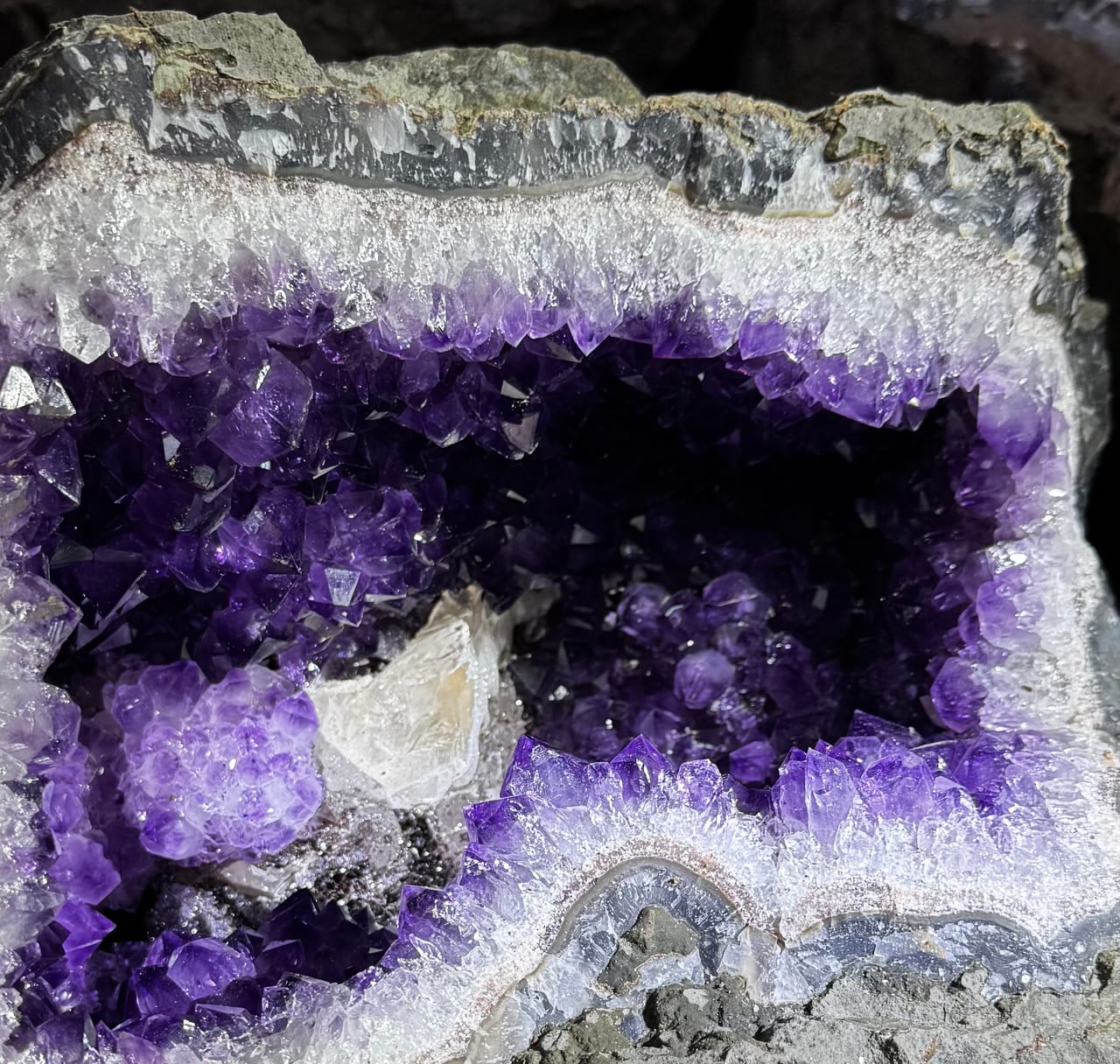
- 1 Outer crust
- 2 Agate
- 3 White quartz
- 4 Amethyst
- 5 Calcite
A geode from Los Catalanes, unretouched. Not every geode has every layer. Sequence: Arduin-Rode et al. 2025, on Los Catalanes. Green celadonite film: Techera et al. 2007; it cannot be seen with the naked eye in this photo.
In some geodes, a green film of celadonite appears between the rock and the agate.
Basalt
More than one hundred million years ago, successive lava flows covered the region. As they cooled, cavities were left inside the rock.
Cavity
Some of those cavities remained sealed inside the basalt.
Agate and chalcedony
Water carrying dissolved silica entered the cavity and left thin layers on its walls: the crust of agate and chalcedony.
White quartz
Quartz crystals began to grow on that crust.
Amethyst
With traces of iron and the rock's natural radiation, the quartz took on the violet of amethyst.
Calcite
In some geodes, calcite later formed on top of the amethyst.
What sets an Artigas geode apart
The geologists who have studied Los Catalanes point to two features of its amethyst: an unusually dark violet and the presence of stalactites in some geodes.
A stalactite is a vertical column inside the cavity. It has an agate core, sometimes hollow, that is later coated with colorless quartz and amethyst. It is not common, and it is one of the signatures of this stone.
A 130-million-year-old rock
The basalt of Los Catalanes is part of the Paraná-Etendeka volcanic province, which covers one and a half million square kilometers. It formed in the Early Cretaceous, between 138 and 128 million years ago, as Gondwana was breaking up and the South Atlantic Ocean was beginning to open. The lava came out in successive pulses and left flows stacked one on top of another.
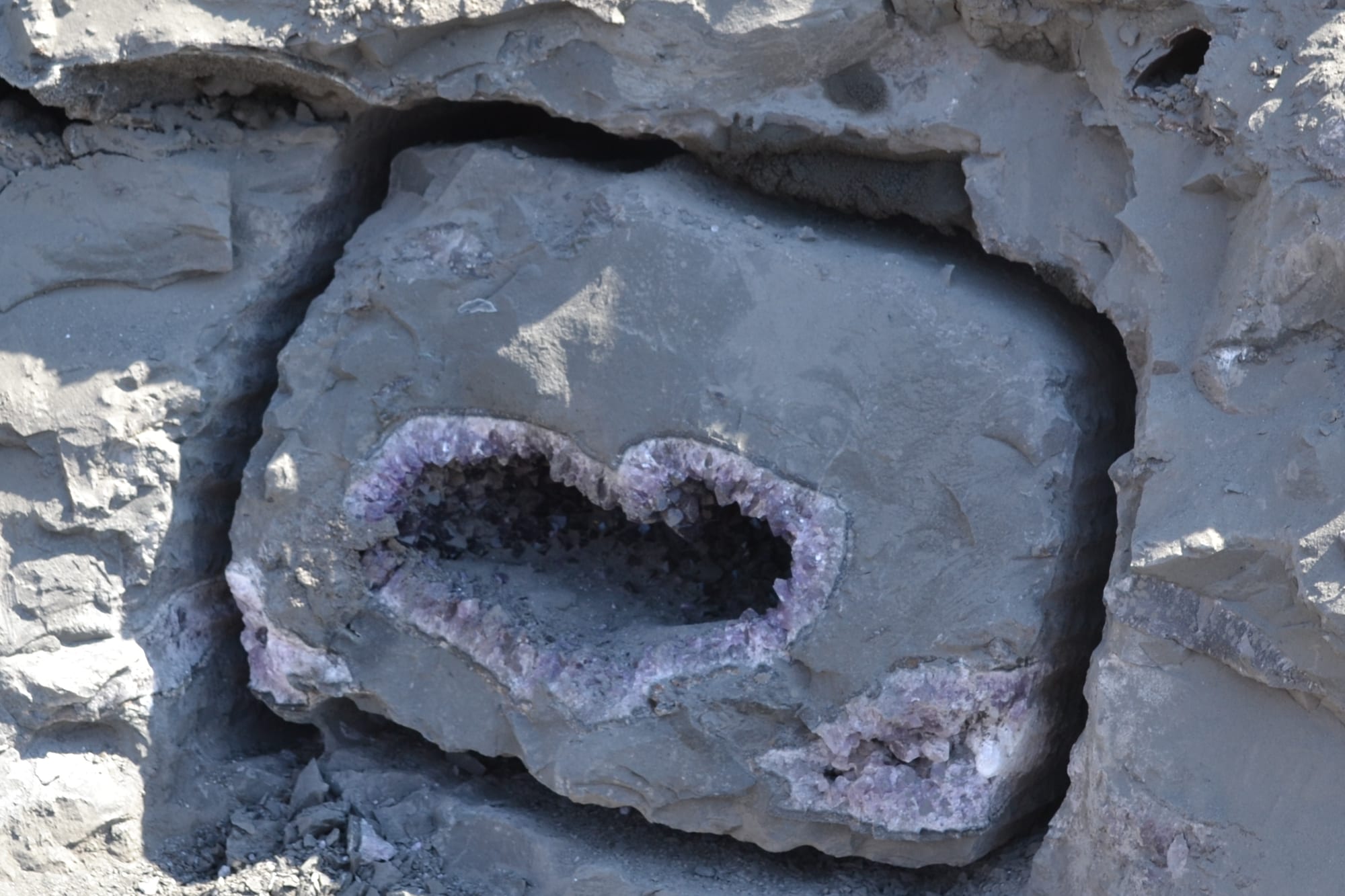
Layer by layer, each geode holds the story of how it formed.
Sources
- Morteani, G. et al. (2010). The genesis of the amethyst geodes at Artigas (Uruguay)… International Journal of Earth Sciences, 99.
- Techera, J., Loureiro, J. and Spoturno, J. (2007). Proyecto Ágatas y Amatistas, Fase I. DINAMIGE.
- Arduin-Rode, F. et al. (2025). World-class amethyst-agate geodes from Los Catalanes, Northern Uruguay. Mineralium Deposita, 60.
- Currier, R. H. (1997). Amethyst, Agate, and Calcite “Skunks” from Uruguay. Rocks & Minerals, 72.
- IUGS Geological Heritage Sites. Deposits of amethysts of Los Catalanes gemological district.